
First International Research Workshop on Quality Infrastructure (QI)

The International Cooperation of the Physikalisch-Technische Bundesanstalt (PTB) and the Chair of Innovation Economics at the Technische Universität Berlin hosted the First International Research Workshop on Quality Infrastructure on the 27th of April 2023. The consulting firm, Mesopartner, supported the preparation and execution of the workshop.

The event took place at the PTB’s Siemens Building in Berlin and online, aiming to bring researchers and practitioners together to discuss the scientific foundation of Quality Infrastructure (QI) and exchange information on the state of research in the field.

During this hybrid workshop over 100 participants from 36 countries, discussed QI’s contribution to economic development and sustainability.
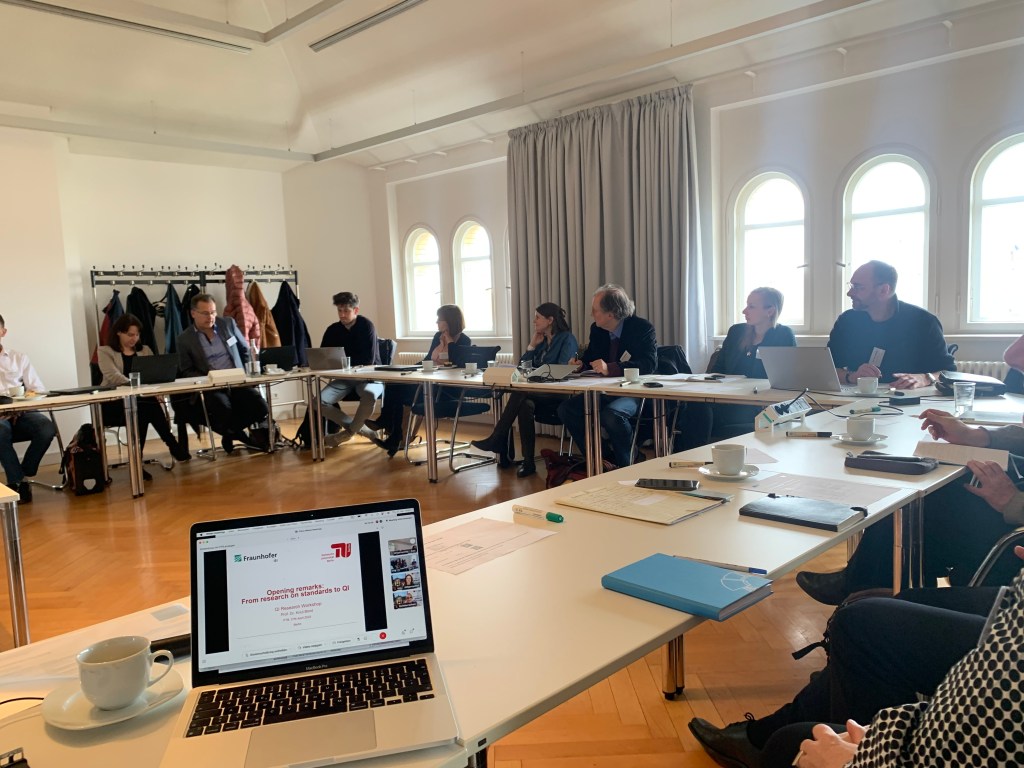
On-site participants during the workshop

Until now, QI has received attention mainly from practitioners. As a result, there is a lot of grey literature and only a few peer-reviewed scientific publications focusing on QI. Against this backdrop, the event made a relevant contribution to the development of QI as a field of research.

To document the results of this first event, the organising team has prepared the following report with the main conclusions and will continue to promote the visibility of QI through further research events, publications and activities fostering the development of data transparency and the components of the quality infrastructure worldwide.


The interaction of QA, QM and QI

What is the difference between quality assurance and quality infrastructure? I was recently asked this question by a young colleague who has just started coordinating projects to promote quality infrastructure. The answer to this question is undoubtedly essential for every newcomer to quality infrastructure. Moreover, it is also a welcome stimulus to think more fundamentally about the relationship between these concepts.

Continue reading

Data on international standards

QI Data Series

What are the differences between countries using international standards?

For decades, the United States, Western Europe and Japan have led international standard development. Representatives of these countries chaired most international standards committees and led standard making through agenda-setting and the know-how of national companies and scientific institutions. Representatives from other countries also participated in standards committees but chaired only a few technical committees. Standards takers are those countries that adopt standards but do not participate in developing those standards.

Continue reading

Women in the Quality Infrastructure System

Gender inequality is still present throughout the world

The world is equally composed of women and men. However, gender inequality is still present throughout the world. As published by the United Nations in October 2020, only 47% of working-age women participated in the global labour market, while for men, the percentage was 74%. This gender gap has remained relatively constant since 1995, i.e., the difference between men and women employed worldwide has not changed in the last 25 years.[1]

Continue reading