Many newcomers to quality infrastructure (QI) struggle to understand the role of metrology, a key domain within the discipline. It can be challenging to grasp how metrology forms the backbone of a QI system, not only in terms of physical metrology, such as measuring weights, length, time, or temperature, but even more so when it comes to chemical metrology.
The “GQII-Report 2023: Insights and Trends on Economies Using Metrology, Standards, Accreditation and Conformity Assessment Services” was published earlier this year using 2023 data. The GQII database and ranking integrate information on quality infrastructure (QI) in 185 economies. Each edition collects and analyses data on standardization, metrology, accreditation and conformity assessment activities. Data from multiple sources is used to ensure comparability and a formula is used to calculate each economy’s score and position in the global QI ranking.
Quality infrastructure is a complex field with specialized terminology and technical details from various areas of expertise. Different institutions offer online learning courses for individuals to become familiar with quality infrastructure. In this blogpost, we will present and compare the QI introductory courses of PTB and UNIDO.
Insights about an economy’s present and future demand for quality assurance services are essential for developing a national quality infrastructure (NQI). Gaining a clear understanding of the needs and demand for QI services in a country complements the analysis of supply-side data, resulting in more sound decisions on QI development programs and their scope. A proper demand assessment is critical to both the capacity building of individual QI Institutions and the identification of effective reforms of the overall NQI in a country. Although the need for demand-driven NQI development is emphasized by funding agencies such as UNIDO and PTB, the demand side is still often neglected.
The event took place at the PTB’s Siemens Building in Berlin and online, aiming to bring researchers and practitioners together to discuss the scientific foundation of Quality Infrastructure (QI) and exchange information on the state of research in the field.
During this hybrid workshop over 100 participants from 36 countries, discussed QI’s contribution to economic development and sustainability.
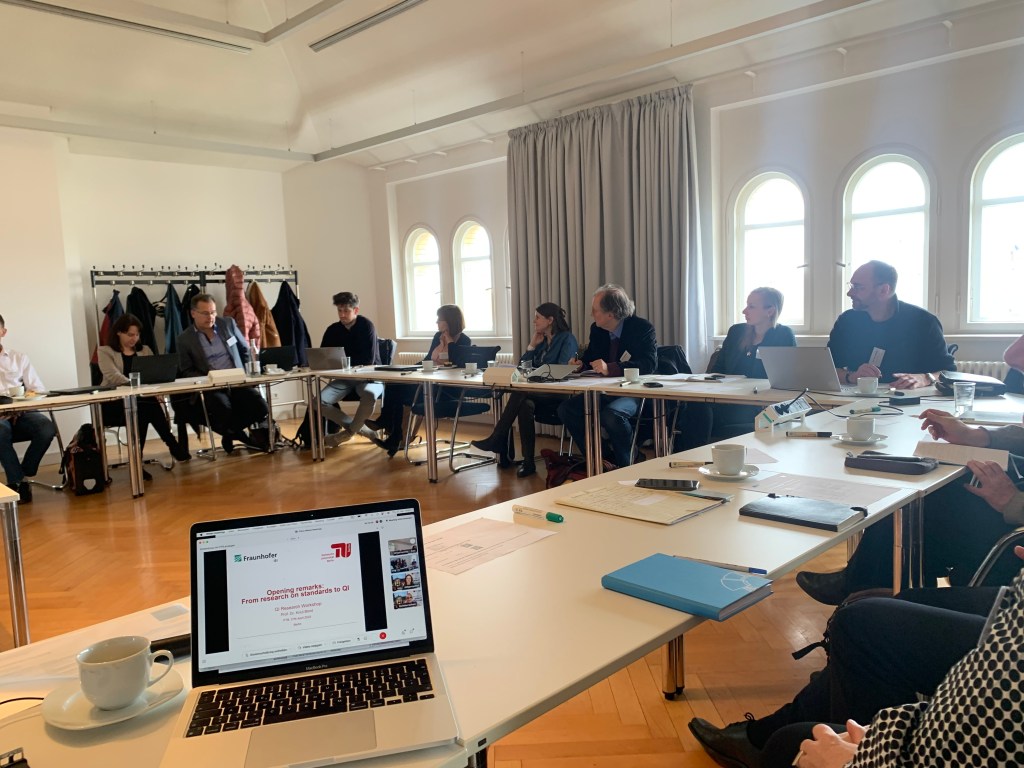
On-site participants during the workshop
Until now, QI has received attention mainly from practitioners. As a result, there is a lot of grey literature and only a few peer-reviewed scientific publications focusing on QI. Against this backdrop, the event made a relevant contribution to the development of QI as a field of research.
To document the results of this first event, the organising team has prepared the following report with the main conclusions and will continue to promote the visibility of QI through further research events, publications and activities fostering the development of data transparency and the components of the quality infrastructure worldwide.


 Quality Infrastructure for Development